A restaurant’s owner opens the monthly P&L examines sales, skips down to the bottom line and then closes the P&L.
Do you recognize the sound?
It may be a perfectly exact report, but by only examining those two figures, you leave the bulk of its value to be debated.
The proper bookkeeping of a restaurant shouldn’t force owners more dependent on their accountant. It should help them become more comfortable with their own financials. You don’t need to be an accountant or stay up all at night filling out invoices. It is important to know how profit moved, what happened to the costs of food and labour and what issues need focus next week.
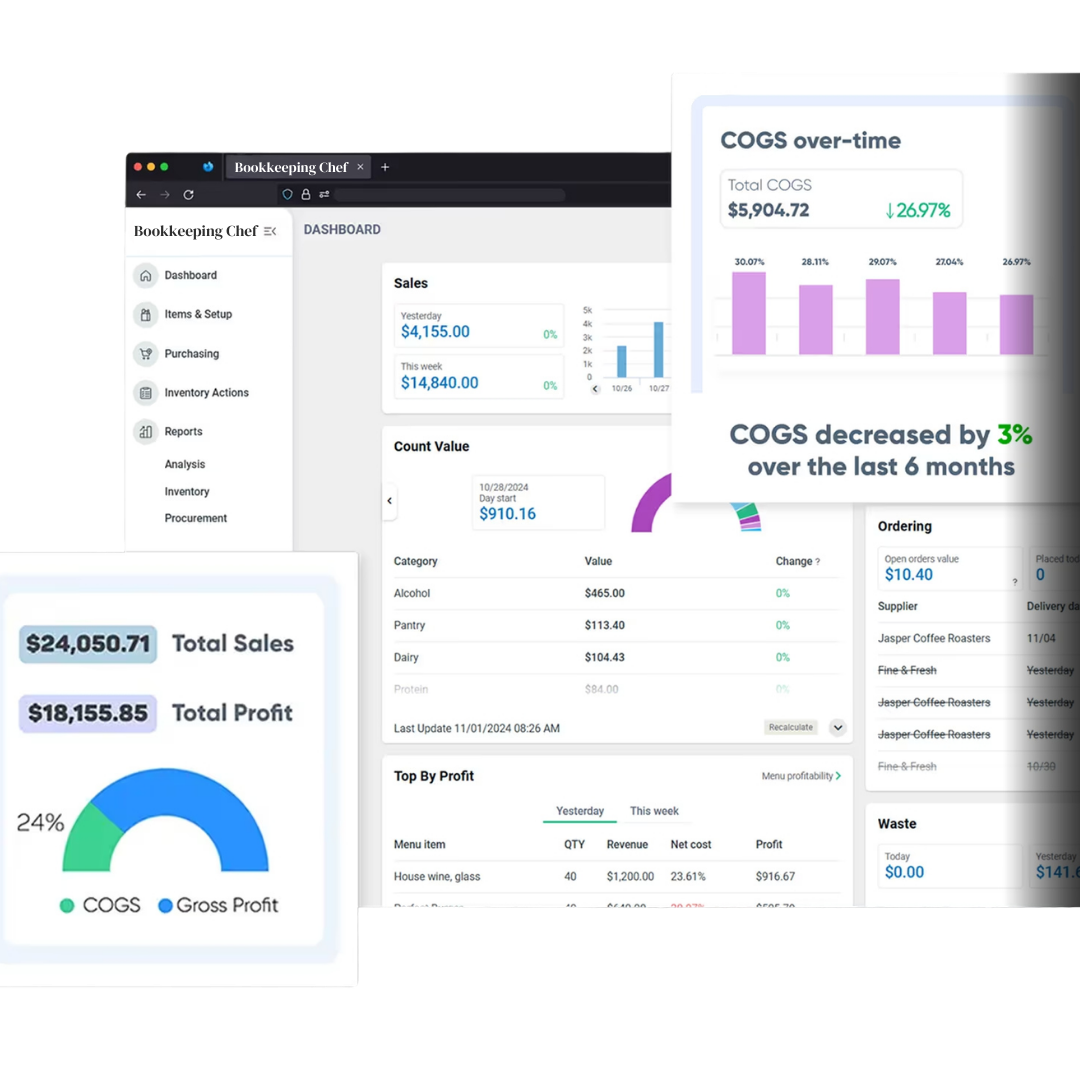
Bookkeeping Chef is an application which automatizes bookkeeping, so users can focus doing other things and receive clearer financial reports.
You should begin by looking at Weekly Numbers and Not Only Month-End
Although restaurants are not operating in a calendar month, they must still have an P&L. Managers schedule labor this week. The chef ordered food today. Vendors change prices now.
The Bookkeeping Chef’s weekly reports on prime costs are available alongside the financial statements for the month.
Prime cost includes price of the goods sold and labor. Both of these are major areas that are able to move quickly in a restaurant. The information provided by the Bookkeeping Chef indicates that prime costs generally account for 60% of sales in restaurants.
Think about a situation where sales aren’t even changing and the costs of primary production are growing. This percentage by itself will not answer the question. It provides the owner with a reason to conduct an investigation.
Did the hourly wage grow? Did there occur overtime? Food costs changed? Was a vendor invoice abnormally high? Changes in the sales mix?
It’s far more beneficial than discovering the same issue several weeks later.
Automate repetitive tasks
DIY bookkeeping doesn’t need to be a manual process of transferring POS amounts into spreadsheets after service.
Automating bookkeeping for restaurants can assist in the repetitive movement of financial data. This service can be connected to POS systems, QuickBooks, vendors platforms as well as recipe management and inventory management, AP/payment instruments.
Automating for the sake automation is not the objective.
The aim is to reduce the need for manual data entry and to ensure that financial records are kept up-to date so that managers are able to take more time in reviewing the data rather than assembling it.
It’s a totally new bookkeeping model for restaurant establishments. Technology handles the mechanics and the proprietor remains involved in the financial side.
If you have more questions, you can ask them about P&L
A P&L can be a lot less intimidating when you stop thinking of it as an accounting exam.
Start by reviewing the sales. Then, take a look at cost of production. Compare the results of food and beverages. Take into consideration the labor. Look at labor.
The importance of comparing periods.
Something between these two lines has changed in the event that sales have increased but the profits haven’t. If food cost increased, ask what happened operationally. Check the levels of staffing and sales activities if labor percentages changed. Investigate any numbers that seem strange, rather than assuming that the restaurant experienced a poor week.
Bookkeeping Chef offers monthly P&Ls, which are finished in five business days. The owners are able to look over the company’s performance without having to wait for months before receiving financial statements.
For owners searching bookkeeping restaurant solutions, speed is useful but understanding is the bigger objective.
It’s not required to make everything.
You can find a happy balance between hiring someone to manage all of your financial tasks as well as being your own accountant full-time.
A business owner can be engaged without having to manually complete each accounting task.
It could be as simple as making use of automated systems to manage the flow of information, examining the monthly P&L and weekly reports on the primary costs, or asking questions if something unexpected happens.
Specialized bookkeeping services for restaurants can aid in this process by maintaining the book’s structure and assisting the owner to comprehend what the reports are saying.
The result isn’t a owner who is skilled enough to complete every bookkeeping task.
Owners can sit down with the P&L and have an intelligent discussion on the business.
The goal is Financial Independence Not More Reports
Restaurants generate a lot of data. Another dashboard might not prove efficient.
Real value is when an operator is able to open an P&L report, be aware that there was a shift and then examine the prime-cost reports.
Bookkeeping Chef’s approach combines restaurant bookkeeping automation weekly reporting and monthly P&Ls. special financial assistance to restaurants in order to make that possible.
Automate repetitive tasks. Review prime cost every week. Learn to speak the same language as your P&L.
There is no need to become an accountant.
You should become a restaurant owner who is aware of the financial story behind your own restaurant.